Author: Emerald Harvest

Advanced Tips

Calcium, Silicon and Structural Integrity

When it comes to growing strong plants that resist infestations, don’t lodge and are capable of bearing prolific, heavy fruits and flowers, structural support is everything.Two nutrients, calcium and silicon, play distinct but complementary roles in building and reinforcing plant structure. Calcium forms the plant’s internal framework; silicon adds an external layer of reinforcement. Because both contribute to sturdiness, their functions sometimes overlap.This post clarifies their roles and explains how applying calcium and silicon together can help growers cultivate healthier …
Advanced Tips

Plant Density and Its Influence on Cannabis Cultivation

Plant density plays an important role in cannabis cultivation. Deciding how many plants to grow per unit area determines your cultivation strategy and influences outcomes like yield and secondary metabolite synthesis. In this blog post, we’ll discuss how plant density affects cannabis production and share strategies for managing denser canopies. Why plant density matters Plant density influences resource allocation, which in turn affects plant morphology. The closer plants grow together, the more they compete for light, water and nutrients. Plant density also …
Advanced Tips

Chelation and Chelates

Plants need secondary macronutrients and micronutrients in smaller quantities than primary macronutrients, and yet deficiencies in the former can be just as harmful to growth and yield as deficiencies in the latter. Micronutrients are particularly prone to becoming unavailable due to nutrient lockout or precipitation from the nutrient solution. Chelation helps to prevent this.In this blog post, we explain what chelation and chelates are, how they work and why they’re essential for nutrient uptake and utilization.Science of chelates A chelate is …
Advanced Tips

Cannabis Plant Morphology

Plant morphology refers both to the scientific study of the external physical structure and appearance of plants and to the descriptive terminology used to characterize these traits.[1] In this blog post, we’ll provide an overview of the descriptive morphology of Cannabis sativa. Morphology matters The morphology of cannabis varies throughout its life cycle in relation to such factors as genetics or strain, environmental conditions and growing techniques. Its height impacts how much light it can receive, as well as its biomass and …
Growing Tips

Pruning Techniques for Cannabis Plants

Pruning selectively removes unnecessary foliage, redirecting the plant’s energy into producing larger, denser, higher-quality buds. It also improves plant morphology, resulting in a better microclimate by increasing light exposure and air circulation around the plant.Cannabis exhibits monopodial growth, meaning it develops a single main stem that grows vertically, and because it is apically dominant,[1] the main stem inhibits the growth of lateral shoots. Pruning the main stem relieves the plant of apical dominance, triggering hormonal changes—specifically, changes in auxin and …
Advanced Tips

Plant Growth-Promoting Rhizobacteria in Soilless Cultivation

Plant growth-promoting rhizobacteria (PGPR) are beneficial bacteria that colonize the root zone, acting as biostimulants, biofertilizers and biocontrol agents that influence plant responses to their environment.Rhizobacteria inhabit the rhizosphere—the region of soil immediately surrounding roots, as well as the sticky root surfaces themselves. This zone regulates key factors such as nutrient availability and microbial interactions that support plant health and survival.Although soilless systems lack a traditional rhizosphere, root surfaces remain bioactive, allowing PGPR to colonize them in hydroponic conditions. This …
Advanced Tips

Sources of Carbon Dioxide Supplementation

Supplementing carbon dioxide (CO2) in the grow room is common in indoor cannabis cultivation. As we discussed in our blog post on CO2 supplementation, CO2 is essential for photosynthesis. By increasing the amount of ambient CO2, growers can boost their plants’ photosynthetic rates, producing bigger yields and shortening the crop life cycle for more frequent harvests. In this blog post, we will discuss the different methods of CO2 supplementation. CO2 injection systems and tanks CO2 injection systems and tanks rank among the most popular ways …
Advanced Tips

A Little Goes a Long Way

Hydroponic nutrients need to be applied in the right concentrations at the right times in the crop life cycle. They also need to be formulated in the right ratios, so that the various essential nutrients complement and balance one another rather than work against each other. Plants need at least a minimum amount of every nutrient essential to plant life. Even if a plant gets more than enough of every essential nutrient except one, it might not thrive. If even one …
Product Spotlight

Build a Better Foundation

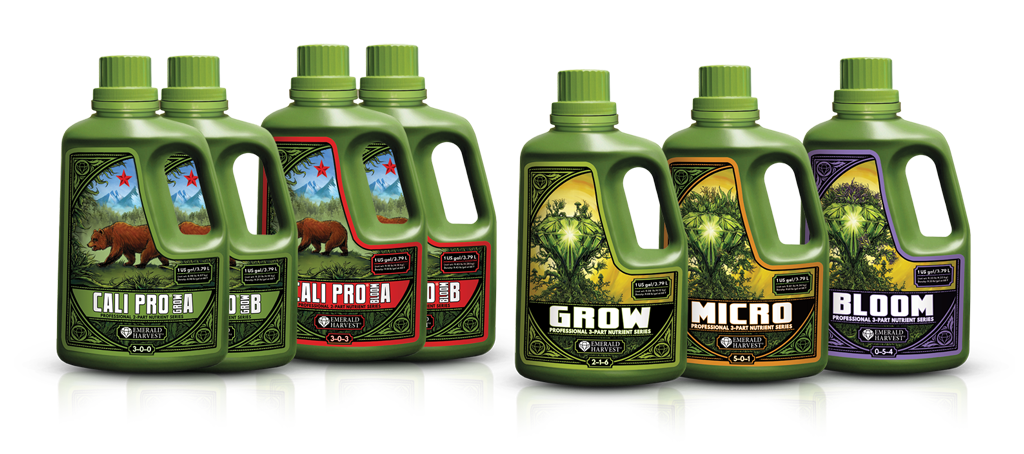
The Emerald Harvest nutrient line is a complete feeding program that’s been purity and quality tested in the lab, with proven results in the field, grow after grow. The starting point is our two professional base nutrient series, which offer your hydroponic plants every nutrient they need and nothing they don’t. Plants need at least a minimum amount of every nutrient essential to plant life. It doesn't matter if a plant gets more than enough of every essential nutrient but one; …
Grower Spotlight

Michigan Home Growers ‘Stick’ to What Works

By Jonathan Katz Shere McKay can rattle off dizzying list of homemade cannabis goods that you would expect to find at an established Michigan dispensary. Vegan cream cheese cookies, salad dressing, nougat (the top seller) and even smoked sausage. The products are her own creations—derived from the home grow that she and her husband Don operate in Otisville, Michigan, just outside Flint. They serve as caregivers under the business name McStickys and sell their products to their patients at a market …
White Paper Blogs

Clearing up the confusion about silicates: Case in point—BioNova Silutio

Silicon-based fertilizer supplements are easy-to-use additions to your feeding program that bring numerous benefits to cannabis gardens, including increased crop quality, strength and resilience. Their ingredients—the raw materials in the bottle—are also simple: They’re predominantly bottled silicates. There’s no mystery to silicates or how they deliver silicic acid* to the roots. Nevertheless, some fertilizer manufacturers get the science behind silicates—and the advice they give to growers as to which type of silicate they should use for best results—just plain wrong. Indeed, …

Inside silicon supplements: Making Sense of What’s inside the Bottle

Silicon packs a powerful punch, increasing crop quality, strength and resilience. Yet the fertilizer market is flooded with misinformation about silicon supplements, including confusing labeling and misleading marketing claims with no basis in science. This poses a challenge for growers seeking to choose the best product. With every nutrient company touting the superiority of its silicon-based product, it’s no wonder growers get confused and struggle to make an informed choice. Even the terminology—silicon, silica, silicic acid, silicate—is often used interchangeably in …
top